
New Braunfels, TX · Garage Door Service
Opener Repair for Schertz's Early-2000s Garage Doors
Schertz openers are mostly 2001-era units now pushing 20+ years old. We drive the 12 miles from New Braunfels to fix gears, boards, and sensors on these aging units.
- Repairs & new doors
- Springs & openers
- Serving 7 nearby communities
What Causes It Around Here
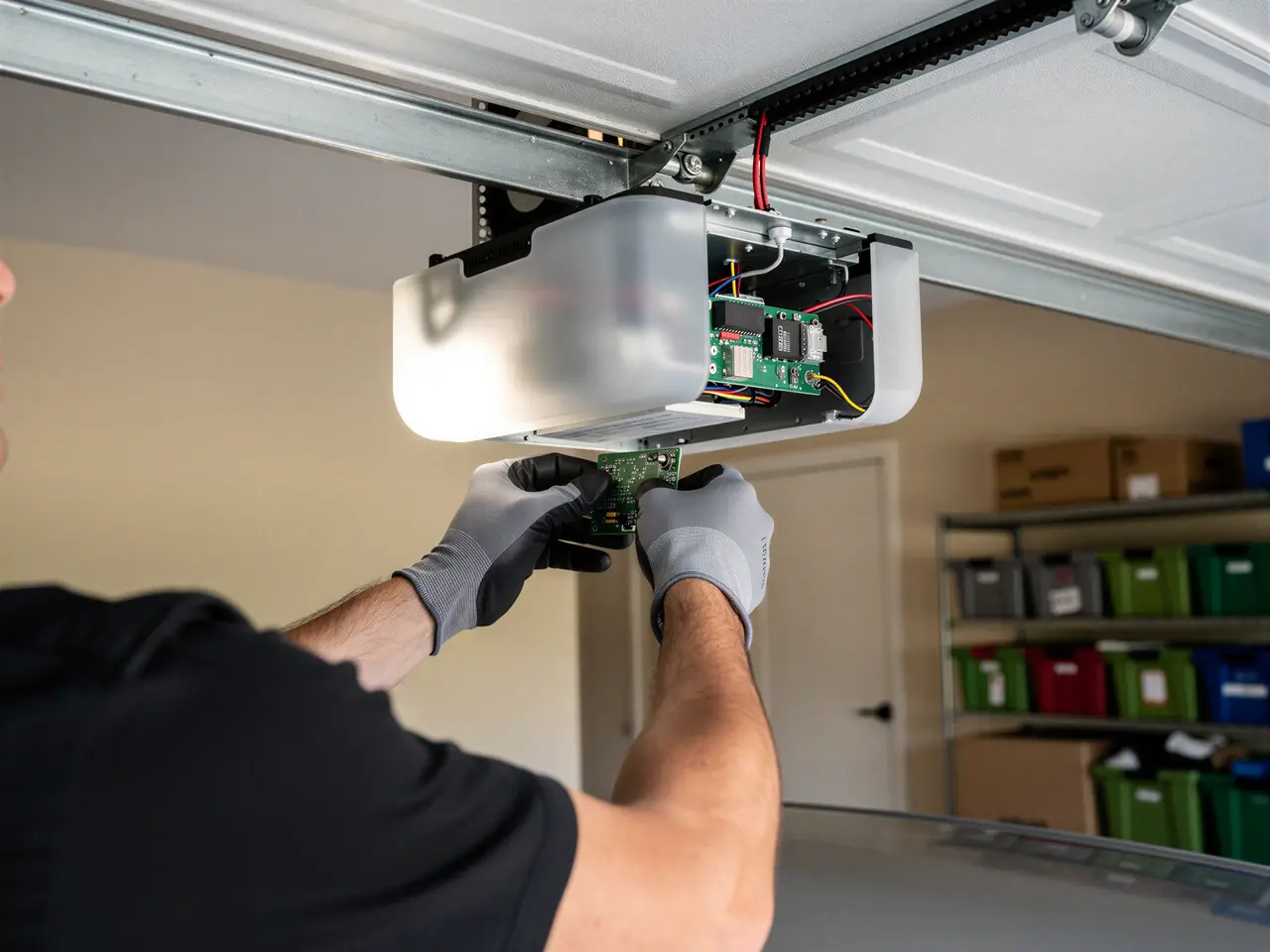
Schertz sits about 12 miles from our shop in New Braunfels, which is close enough that a tech can carry a full bin of opener parts on the truck rather than guess at what to bring and come back twice. That matters here because of what's actually failing. Most Schertz houses went up around 2001, smack in the middle of the 1984-2010 building wave across this whole service area, and that means a lot of original garage door openers are now pushing twenty years of service. These aren't new failures from storm damage or a bad install. They're wear failures: nylon drive gears that have finally stripped their teeth, logic boards whose capacitors have dried out, safety-eye sensors that have crept out of alignment after two decades of the garage door getting bumped by bikes and coolers. Texas summers push garage temperatures well past what these circuit boards were designed to sit at for years on end, and heat is hard on electronics long before it's hard on the motor itself. By the time an opener from that era quits, it's rarely one single part - it's the accumulated wear of a machine that was built for an 11-to-15-year service life and has gone well past it.
The Cost of This Job
We don't post a flat number here because opener repair in Schertz splits into two very different jobs and the facts don't support pretending otherwise. A sensor realignment or a worn drive gear swap on a unit that's otherwise sound is a small, contained repair. A dead logic board on an opener old enough to match Schertz's 2001 housing stock is a different conversation, because boards for discontinued chain-drive models from that era are often harder to source than the motor itself, and at that point we're usually talking replacement instead of repair. Household income in this part of the service area runs well above the broader area median of $85,235, and we mention that only because it shapes a real decision homeowners here actually face: spend to keep a two-decade-old opener alive another year or two, or put that money toward a current unit with a longer runway ahead of it. We'll tell you straight which side of that line your opener is on once we've had the cover off and looked at the board.
Time on the Job
Most opener repairs are a single visit - diagnose, replace the failed part, test the safety reverse, done. What stretches a job isn't the wrench work, it's parts availability. An opener that matches the common 1980s-90s and early-2000s stock across this area usually has parts we can source without much delay. An oddball unit, or a board for a model that's been out of production a long time, can mean an order and a second trip. We'd rather tell you that up front than promise a same-visit fix and miss it. If the diagnosis points to full replacement rather than repair, that's typically still a single visit, since a new opener doesn't carry the sourcing problem an obsolete board does. Either way, the drive from New Braunfels is factored into how we schedule the day, not into how long the repair itself takes once we're there.
What the Repair Takes
For a Schertz opener from the early-2000s building wave, the repair usually comes down to one of a few things: the drive gear and sprocket kit (plastic, and the first thing to wear on a chain or belt unit run hard for twenty years), the logic board, the safety-eye sensors and their wiring, or the wall control station. We carry common gear kits and sensor pairs on the truck given how often they come up on housing stock this age. Boards are the honest limitation here - once a manufacturer stops making a model, the board can take longer to source than we'd like, and on some older units it isn't available at all, which is when repair stops being the right call and replacement takes over. We won't install a board we can't warranty just to say we fixed it the same day.
What You Are Seeing
The opener runs but the door won't go all the way up or down - usually a sensor or a limit setting drifting after years of use. The motor hums but the door doesn't move - often a stripped gear, especially on units from the early 2000s that have logged thousands of cycles. The opener reverses for no reason midway through closing - almost always the safety-eye sensors, either misaligned or wired loose. Remote works intermittently or not at all - can be the remote itself, but on an opener this age it's just as often a board starting to fail. A burning-plastic smell from the unit is a stripped gear cooking against the housing, and it's worth shutting the opener down and using the manual release until someone looks at it.
Can You Do This Yourself
Realigning a safety sensor or reprogramming a remote is reasonable to try yourself - it's two screws and a level, and there's no spring tension involved. Replacing a drive gear kit means opening the motor housing and handling the chain or belt under tension, which is where DIY attempts on openers this age tend to go sideways, especially if the unit still has a working torsion spring system attached. Board swaps aren't a parts-store job at all - matching the board to the motor and the safety circuit takes more than plugging in a replacement. If your opener is original to a Schertz home built around 2001, treat any repair beyond the sensor and remote level as a call, not a weekend project. A door that reverses unpredictably or doesn't fully close is a safety issue first and a convenience issue second.
Frequently asked questions
How far out is Schertz from your shop, and does that affect scheduling?
Schertz runs about 12 miles from our base in New Braunfels. We route it into the day's schedule alongside other service-area calls rather than treating it as a special trip, and the truck carries parts suited to this area's early-2000s opener stock so the drive doesn't turn into two trips.
Why does my opener keep reversing before the door closes?
On openers from Schertz's early-2000s housing wave, this is almost always the safety-eye sensors near the bottom of the tracks - either knocked out of alignment or with a loose, corroded connection after years in a Texas-summer garage. It's a sensor fix, not a motor problem, in most cases we see.
Is it worth repairing an opener this old or should I replace it?
Depends what's failed. Gears and sensors are worth fixing on an otherwise sound unit. A dead logic board on a discontinued model built around when most Schertz homes went up often costs more to source than a new opener costs to install, so at that point replacement is usually the better call.
Do you stock parts for openers this age?
We carry common gear kits, sensor pairs, and wall controls that match the 1980s-through-2000s stock typical across this service area. Boards for discontinued models are the exception - those sometimes need to be ordered, and a few older units don't have a board available at all.
Book garage door service in New Braunfels
Call now or request a quote - tell us what the door is doing and where you are.